

Introduction
In modern mechanical transmission systems, gear failures cause billions in annual losses from unplanned downtime. Common issues include premature wear, excessive operational noise, and rising energy costs from inefficiency. Many engineers still rely on outdated cutting standards or generic solutions.
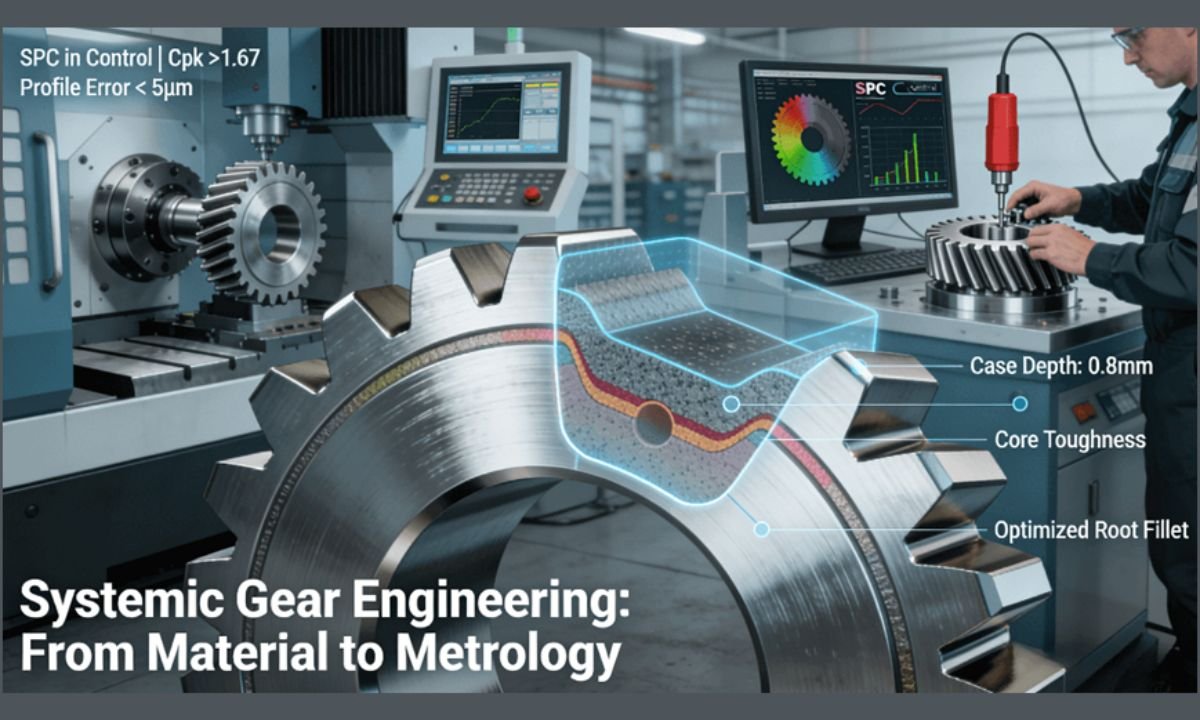
These problems often stem from a fragmented view of gear cutting as a series of isolated steps—material, design, heat treatment, and finishing—rather than as a single, integrated systemto be optimized holistically. This article delves into a systematic gear cutting methodology that integrates materials science, precision engineering, and advanced manufacturing. By optimizing every link in the chain, from material selection to final heat treatment, it’s possible to significantly extend gear life, reduce noise, and boost overall transmission efficiency. The following sections deconstruct the five key dimensions of this systemic approach.
What Is Gear Cutting, and Why Does a Holistic Approach Matter More Than Ever?
This section redefines modern gear cutting as a complex system integrating dynamic mechanics, material behavior, and surface engineering, arguing that a holistic, integrated optimization approach yields transformative performance gains that isolated improvements cannot.
1. From Basic Machining to Systemic Engineering
Modern gear cuttingtranscends the basic definition of removing material to form teeth. It is a complex systemic engineeringdiscipline that integrates dynamic load mechanics, material tribology, and surface integrity science. Each cut influences the gear’s residual stress profile, microgeometry, and subsurface characteristics, which collectively determine its performance under real-world operating conditions.
2. The Limitation of Isolated Optimization
Focusing solely on achieving perfect tooth profile accuracy, while neglecting material compatibilityor heat treatment response, often yields limited returns. For instance, a geometrically perfect gear made from a steel with poor hardenability will fail prematurely under load. As highlighted in authoritative resources like the ASM International Handbookon material-process synergy, true performance stems from the harmonious interaction of all variables, not the maximization of one.
3. The Compounding Benefit of a Systems View
Adopting a holistic approachenables compounding benefits. By co-optimizing material selection for machinability and final properties, tailoring cutting parameters to minimize heat-affected zones, and synchronizing heat treatment to lock in performance, engineers can achieve a 25%+ performance boostin power density, efficiency, or service life. To fully master the complete knowledge system from principle to practice, this comprehensive guide to gear cutting provides valuable insights.
How Does Material Science Dictate the Success or Failure of a Cut Gear?
This section explores the fundamental differences between common gear materials (case-hardening steels, induction hardening steels, PM) in terms of machinability, heat treatment response, and final performance, emphasizing that Design for Manufacturability (DFM) starts with material selection.
- The Foundation: Choosing the Right Alloy for the Job: Gear material sciencebegins with selecting the optimal alloy for the application’s specific demands. Common choices like case-hardening steels (e.g., 20CrMnTi), induction hardening steels, and powder metallurgy (PM) materials have fundamentally different characteristics. Case-hardening steels offer a hard, wear-resistant case with a tough, shock-absorbing core, ideal for high-contact-stress applications. PM allows for complex geometries and good wear resistance but with different porosity and strength profiles. The wrong material choicefundamentally limits performance.
- Machinability and the Genesis of Defects: A material’s machinability—how easily it can be cut—directly dictates the cutting process and final gear quality. Poor selection can lead to built-up edge (BUE)on cutting tools, causing poor surface finish, accelerated tool wear, and introducing micro-cracks that become stress concentrators. Post-machining, improper material can lead to excessive heat treatment distortionor insufficient core strength, rendering the part useless despite precise geometry.
- DFM Begins with Material Selection: True Design for Manufacturability (DFM)starts not at the CAD stage, but at the material specification phase. It involves understanding how a chosen alloy will behave during cutting (chip formation, cutting forces) and subsequent hardening processes. Selecting a material with good hardenabilityand dimensional stabilitythrough heat treatment is as critical as its final hardness, ensuring the gear can be manufactured andwillperform reliably.
Can Heat Treatment Truly Make or Break Gear Performance After Cutting?
This section positions heat treatment not as an isolated post-process, but as a critically coupled phase that “locks in” performance, discussing how to predict distortion and control microstructure to enhance properties like contact fatigue strength.
1. More Than a Post-Process: The Performance Lock
Heat treatment—processes like carburizing, nitriding, and induction hardening—is not merely a finishing step. It is the performance-defining phasethat transforms a soft, machinable “green” gear into a hard, durable component. It determines the final surface hardness, core toughness, and residual stress state, which directly influence wear resistance, bending strength, and fatigue life.
2. Managing Distortion: The Art of Prediction and Compensation
Heat treatment inevitably induces dimensional changesdue to phase transformations and stress relief. Precision manufacturers don’t just accept this; they actively manage it. Through finite element analysis (FEA) simulationand historical data, they predict distortion patterns and implement pre-compensation strategiesduring the cutting stage. Techniques like “pre-distortion” machining ensure the gear distorts intothe correct final geometry during heat treatment.
3. Microstructural Control for Enhanced Performance
The goal is precise microstructural engineering. For example, in carburized gears, controlling the amount of retained austeniteis crucial. While some retained austenite can improve toughness and contact fatigue life by absorbing stress, too much reduces surface hardness and dimensional stability. Advanced controlled-atmosphere furnaces allow for precise carbon potential and temperature control to achieve the optimal balance, directly translating to longer service life and lower noise.
Hobbing, Shaping, or Milling: Which Gear Cutting Method Delivers Optimal Value for Your Project?
This section provides a clear comparison of the three primary gear cutting processes—hobbing, shaping, and milling—contrasting their economics, precision, and flexibility to guide optimal selection based on volume, geometry, and budget.
1. Gear Hobbing: The Champion of High-Volume Efficiency
Gear hobbingis a continuous, generating process ideal for the high-volume productionof external spur and helical gears. Its high material removal rates and excellent profile accuracymake it the most cost-effective choice for large batch sizes. However, it is limited to external gears and requires dedicated, complex hobs for each gear module and pressure angle.
2. Gear Shaping: The Specialist for Internal and Complex Profiles
Gear shapinguses a reciprocating cutter and is uniquely capable of producing internal gears, gears very close to shoulders, and certain intricate profiles (like cluster gears) that a hob cannot access. While generally slower than hobbing, its unique geometric flexibilitymakes it indispensable for specific applications where other methods are not feasible.
3. CNC Gear Milling: The Flexible Powerhouse for Complexity and Prototypes
CNC gear milling, particularly with 5-axis machines, offers unparalleled design freedom. Using standard end mills, it can create complex, non-standard tooth profiles, bevel gears, and prototypes without the need for expensive custom tooling. Its digital flexibilityeliminates lead times for hob procurement, making it the superior choice for low-volume production, prototyping, and highly customized gears, despite potentially longer cycle times per part.
What Are the Unspoken Rules for Transitioning from a Gear Prototype to Mass Production?
This section reveals the critical, often-overlooked “tribal knowledge” required for a smooth scale-up, focusing on leveraging prototype data for tooling optimization, establishing SPC baselines, and ensuring heat treatment consistency.
1. Data Inheritance: From Prototype Insight to Production Wisdom
A successful transition hinges on data-driven scaling. The prototype phase is a rich source of information: cutting force datainforms optimal feeds and speeds for mass production, extending tool life; chip formation analysishelps select the best tool coatings; and initial surface finish measurementsset the baseline for quality standards. This knowledge turns prototyping from a validation step into a process optimization engine.
2. Establishing the Statistical Process Control (SPC) Foundation
The first-article inspection report from the prototype is not just a pass/fail document; it is the cornerstone for Statistical Process Control (SPC)in mass production. Key dimensions and tolerances measured on the prototype become the control limits and targets for the production SPC charts. This ensures that the process capability (Cpk)achieved in prototyping is maintained and monitored throughout the production run.
3. Ensuring Process Consistency, Especially in Heat Treatment
Perhaps the most critical yet variable step is heat treatment. Scaling up requires moving from a single-batch, lab-like environment to repeatable, high-volume furnace runs. Ensuring batch-to-batch consistencyrequires rigorous control of furnace atmosphere, temperature uniformity, and quenching parameters. A seamless transition often necessitates partnering with a gear fabrication services provider that has deep, integrated control over the entire manufacturing chain, from cutting to hardening.
Beyond ISO Ratings: What Should You Really Look for in a Gear Cutting Partner?
This section provides a practical supplier evaluation checklist that goes beyond basic certifications, focusing on tangible capabilities in tool life management, in-process metrology, and integrated process control.
- Tool Life Management and In-House Expertise: Look beyond the machine. Does the partner have in-house tool regrindingand advanced coating capabilities(like TiAlN, AlCrN)? This indicates deep control over one of the most critical cost and quality variables. The ability to monitor tool wearin real-time and predict failure before it impacts part quality is a mark of a mature operation.
- In-Process Metrology and Closed-Loop Compensation: Certificates are retrospective; in-process controlis proactive. Does the shop use on-machine probing or in-line gear inspection systems? More importantly, can they implement real-time tool compensationbased on measurement feedback? This closed-loop capability is what separates shops that inspectquality from those that manufactureit consistently, a discipline often found in facilities adhering to stringent standards like IATF 16949or AS9100D.
- Integrated Process Control and Collaborative Depth: Is heat treatment a black-box subcontractor or an integral, collaboratively managed part of their process? The deepest expertise comes from partners who manage or tightly integrate the entire value chain. Evaluate their collaborative depth: Do their engineers engage in pre-production DFM meetings to discuss material and heat treatment implications? This systemic approach is the true hallmark of a partner capable of delivering high-performance custom gear designsolutions.
Conclusion
Exceptional gear performance is not accidental. It is the result of mastering the entire ecosystem behind the verb “to cut”—from the molecular science of materials to the dynamics of the machine tool, to the phase-transformation art of heat treatment. By adopting the systemic engineering perspectiveoutlined here, engineers can elevate their transmission designs from “good enough” to robustly reliable, achieving significant gains in durability, efficiency, and quiet operation.
FAQs
Q: What’s the primary difference between gear hobbing and gear shaping in terms of application?
A:Hobbing is a continuous, faster process ideal for high-volume production of external spur and helical gears. Shaping, while slower, is uniquely capable of creating internal gears, gears very close to shoulders, and certain intricate profiles that a hob cannot access. The choice hinges on gear geometry, batch size, and cost targets.
Q: How does heat treatment affect the dimensional accuracy of a cut gear?
A: Heat treatment induces dimensional changes due to phase transformations and stress relief. Precision gear makers predict this through simulation and historical data, then pre-compensate during cutting—a technique known as “pre-distortion.” Controlled processes like vacuum carburizing minimize distortion, but some change is inevitable and must be accounted for in the design and machining stages.
Q: What file format is best for providing a gear design for quotation?
A: A fully-defined 2D drawing in PDF or DXF format with complete GD&T is essential. Providing a 3D STEP or IGES file alongside the drawing is highly recommended, as it allows for automated manufacturability analysis and more accurate quoting, especially for complex geometries.
Q: Can you achieve high precision with gear milling for low-volume production?
A: Absolutely. Modern multi-axis CNC gear milling, especially with advanced tool path strategies, can achieve precision levels comparable to dedicated hobbing machines for prototypes and small batches. Its flexibility eliminates the need for expensive custom hobs, making it cost-effective for low volumes without sacrificing critical quality.
Q: What are the key indicators of quality in a cut gear beyond the tooth profile?
A: Beyond tooth form, critical indicators include: Surface integrity (absence of white layer/burn), root fillet quality (smooth transition to avoid stress risers), lead and pitch uniformity across the entire gear face, and residual stress profile. A comprehensive quality report should include data from gear analyzers and sometimes even metallographic cross-sections.
 Siam
Siam