

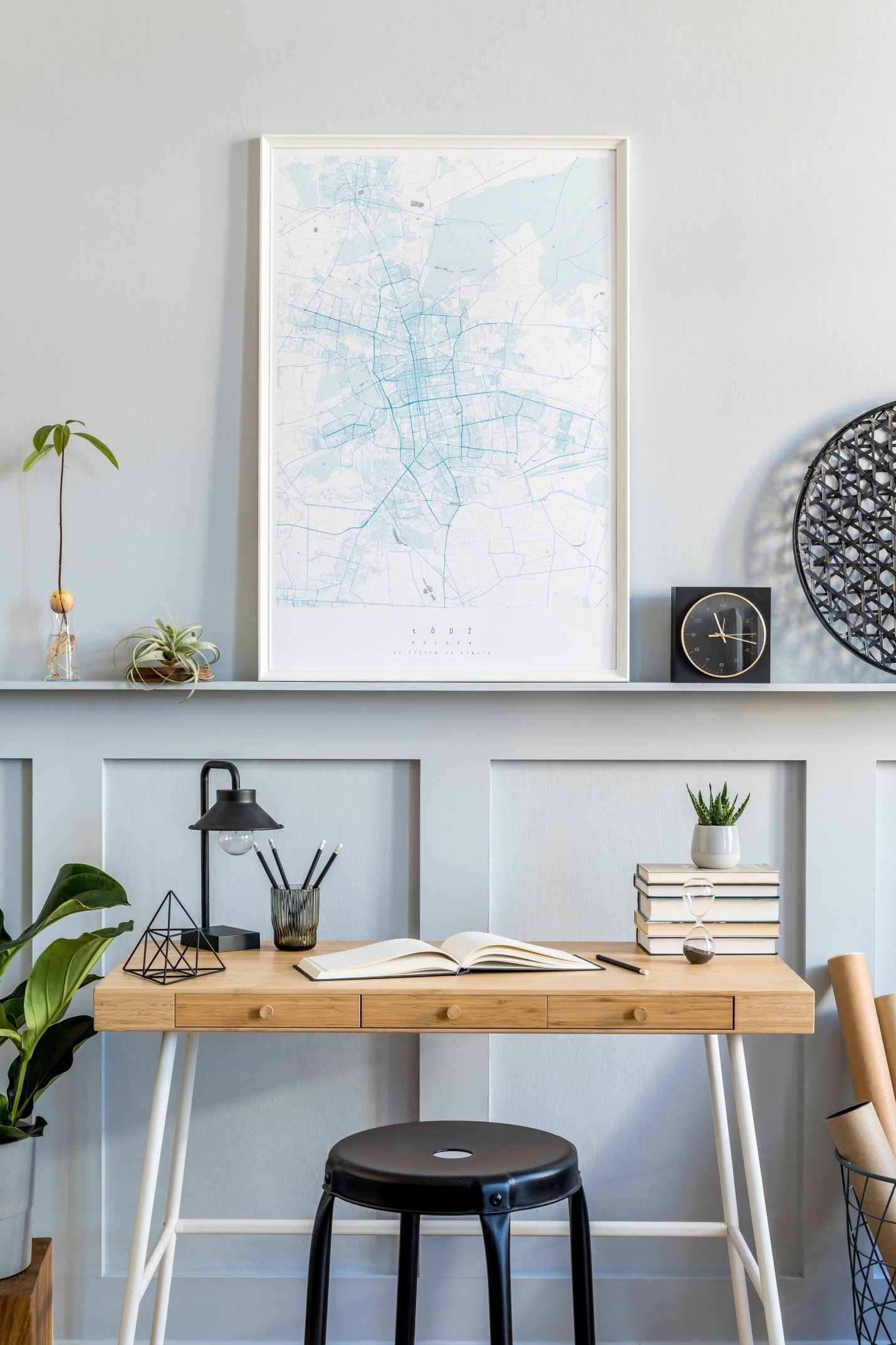
The more things you have, the more challenging it can be in a small space.
There’s often the urge to add more to help fill it out — more furniture and more décor, but this rarely works. On the contrary, it tends to make space feel crowded and busy rather than full and complete. The best place to start designing any small space is with the process of simplifying. Only keep what you actually use, what has a clear function. Having less, but choosing carefully, will visually fill a room more than having a lot of disparate small pieces. Open armed pieces continue your sight line through the room and keep you from feeling closed in.
Make Storage Work Invisibly
Small spaces require strategic storage, but function shouldn’t outshine form. The best solutions are often those that are built right in, stylishly disguised. Beds that sit on top of wheeled drawers, an ottoman with a hollow interior, cabinets anchored high on the wall rather than the floor- all of these methods ensure that floor space remains relatively open and that the eyes pass freely from one end of the room to the other. If vertical storage is necessary, try to make it an integral part of the room, instead of being just there to store things. When storage becomes one of the space’s hidden strengths, instead of its loud-mouthed martyr, it becomes less of a distraction and more of a comfort.
Use Lighting to Add Depth
You can make or break the way you feel in a bijoux room with your lights. Just using ceiling lights can make things look a little cramped and forced. The key? More, more, more. The smaller lamps dotted around (table lamps, floor lamps), the better. Wall lights, too. Downlighters even (ever upwards, those ones). And get it on different levels (if it looks uniform, make one light shorter or taller). Your eye will travel around the room if it’s kept busy with light.
Plan the Room Before You Move Anything
Besides bedding for properly situated items, room planning is perhaps where most small-space miscues can be avoided. Looking at the placement of pieces in a room and guessing will leave you guessing at the variables that will affect how everything sits together. However, making an effort to design your room will actually provide you with the opportunity to see where circulation paths flow unobstructed through the room, in addition to whether everything fits properly. Visualizing the layout in digital tools will also make it easy to try a few different configurations to see how placement choices affect traffic areas, as well as which pieces might appear too large and out of place.
Create Visual Consistency
Consistency is one of the most underrated small-space design tricks. Using a smaller color palette, using materials in multiple places, and sticking to one style make a place feel like it belongs together and was intentionally designed. When you have too many conflicting colors or finishes, your eye doesn’t know where to go, and it makes the space feel smaller. But when something looks intentional, your eye moves around the space, and it feels bigger.
Again, good small-space design is less about smoke and mirrors and more about careful decision-making. Use these tips, some smart lighting, and a tool like planner 5D to feel at home and make the most of even the tiniest space.
READ ALSO: Contemporary Art in Public Urban Spaces Guide
 Issam
Issam  Arthur