

Introduction
In the medical device and aerospace sectors, the reliability of electronic systems is directly tied to life and mission success. Traditional, generalized manufacturing processes often struggle with highly integrated, miniaturized Printed Circuit Boards and their associated precision metal components, leading to issues like yield fluctuations, inadequate thermal management, and electromagnetic interference (EMI) shielding failures.
The root cause of these problems frequently lies in insufficient precision between structural components and the PCB, coupled with the difficulty of maintaining consistency in mass production. Standardized machining services may fall short of the stringent demands for tight tolerances, material purity, and traceability required for medical-grade or aerospace-grade applications.
This article demonstrates how an integrated approach, combining advanced CNC turning services with sophisticated CNC Machining Services, enables manufacturers to overcome these hurdles. This solution is particularly adept at producing critical Aerospace Components and Medical Device Parts such as connector housings, shielding enclosures, and heat sink bases.
Why Do High-Density PCB Designs Demand Near-Absolute Precision from Metal Components?
The relentless trend toward miniaturization in modern electronics, especially in implantable Medical Device Parts and satellite communication modules, has pushed component spacing on Printed Circuit Boards to the millimeter and sub-millimeter scale.
The Direct Consequence of Miniaturization
This extreme density necessitates that accompanying metal connectors, test point interfaces, or shielding housings achieve ultra-high precision. These components become the sole physical bridge for electrical connection and signal exchange between the circuit and the external world.
The Cascading Risk of Imprecision
Any micron-level dimensional or positional deviation can result in poor mating contact, increased contact resistance, or misaligned signal channels. In medical devices, this could mean failed data acquisition; in aerospace systems, it could trigger command transmission errors. Therefore, the accuracy of metal components directly dictates the absolute reliability of electrical connections.
Precision Driven by Compliance
l Regulatory Emphasis on Consistency
Authoritative regulatory bodies have clear requirements on this front. For instance, the U.S. Food and Drug Administration (FDA) emphasizes in its “Design Control” guidance that manufacturing processes must possess high predictability and consistency.
l The Role of Advanced Machining
This stringent demand for consistency naturally highlights the value of CNC turning processes. This technique offers unique advantages in maintaining exceptional axial and radial tolerances (consistently achieving ±0.005mm), providing the technical prerequisite for meeting precise assembly needs.
What Role Do CNC Machined Parts Play in Thermal Management and EMI Shielding?
In high-frequency, high-power electronic devices like radar transmitters or medical imaging equipment, thermal management and electromagnetic compatibility (EMC) are two paramount challenges for their Printed Circuit Boards. Overheating degrades component performance or causes failure, while EMI can distort sensitive signals.
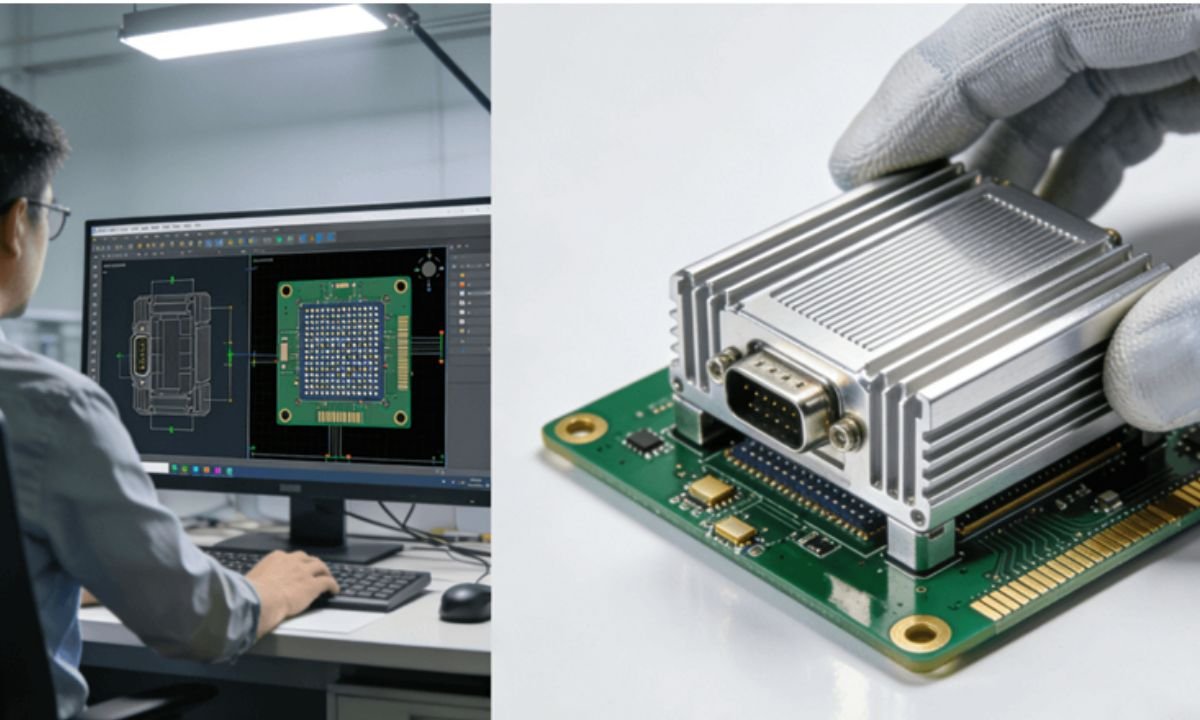
Here, custom metal parts fabricated through CNC Machining Services become the critical solution. Engineers can design and machine housings with complex curved cooling fins, bases integrating internal vapor chambers, or EMI shielding covers with precision sealing grooves. These parts achieve perfect conformity with the PCB and its heat-generating components, maximizing contact area to optimize heat conduction paths and ensure the continuity of electromagnetic shielding for maximum effectiveness.
This advantage is even more pronounced in Aerospace Components Manufacturing. Under strict weight constraints, integrally milling complex internal cooling channels from a solid block of aluminum or copper alloy via precision machining is significantly more reliable and efficient than traditional multi-part brazing or assembly methods. It achieves notable weight reduction and completely eliminates leakage risks. Reports from the National Aeronautics and Space Administration (NASA) on advanced thermal management technologies for electronics acknowledge that precision additive and subtractive manufacturing are central to realizing next-generation, high-performance, high-reliability thermal control systems, underscoring the effectiveness of precision machining in solving extreme thermal challenges.
From Blueprint to Volume Production: How to Ensure Every CNC Turning Part Perfectly Fits the PCB?
Guaranteeing that thousands of CNC turning parts mate flawlessly with a PCB relies on an interlinked, highly controlled precision manufacturing workflow.
Starting with Collaborative Design
The process begins with early-stage collaboration with the PCB design team. Structural engineers must perform Design for Manufacturability (DFM) based on the PCB layout, pad locations, and component heights, ensuring the structural part is not only functional but also efficiently and accurately producible.
The Core: Intelligent CNC Turning Programming
l From Model to Machine Code
This is the heart of transforming design into reality. During the CNC turning programming phase, engineers convert the 3D model into an executable CNC turning program.
l Parameters Dictating Quality
The optimization of tool paths and the selection of cutting parameters for different materials (such as aerospace aluminum or medical-grade PEEK) directly determine the part’s surface finish, dimensional stability, and microstructure—properties that profoundly impact subsequent soldering or press-fit quality with the PCB.
Key Technology for Zero Variance
Modern CNC turning centers are equipped with on-machine probing and tool compensation systems. During or after machining, probes automatically measure critical dimensions, feeding real-time compensation data back to the control system to adjust tool offsets automatically. This enables near-zero variance machining consistency within a single batch and across multiple production runs.
A comprehensive quality system (such as IATF 16949, which emphasizes process control, or AS9100 for aerospace) ensures every step—from raw material intake to finished goods shipment—is documented and traceable, ultimately guaranteeing that every delivered CNC turning parts conforms perfectly to the drawing specifications.
How Does CNC Turning & Milling Combined Technology Overcome Limitations of Complex Geometries?
Many electronic device housings are not simple bodies of revolution. A connector shell, for example, might have a cylindrical main body but require lateral datum planes, mounting holes, or irregular locking features. Pure CNC turningis insufficient for such tasks.
Modern multi-axis CNC turning centers integrate milling spindles, enabling CNC turning & milling complete machining. This means a part can be fully processed in a single setup: first, turning features like outer diameters and internal bores are completed, then the milling spindle activates to machine various complex structures on the side, all without changing the workpiece clamping.
Consider an aluminum housing for a high-speed data connector: the blank is first turned to create the precise main contour and interface threads. Then, without re-clamping, the same machine uses an end mill to produce the side datum keyway and screw holes. This method completely eliminates datum errors introduced by secondary setups, ensuring extreme positional accuracy of all features relative to the PCB mounting surface while significantly boosting machining efficiency. This integrated processing strategy is invaluable for Medical Device Parts, which require rapid iteration and rigorous validation, as it can substantially shorten the development cycle from prototype to certification.
Choosing a Partner: Beyond Fast Quote, What Manufacturing Capabilities Should Be Evaluated?
Selecting a CNC turning service provider requires looking beyond just price and lead time. For high-reliability aerospace and medical projects, a deeper evaluation of comprehensive manufacturing capability and quality foundation is essential.
| Evaluation Dimension | Key Capabilities &Certifications | Importance to the Project |
| Material & Process Expertise | Proficiency in machining medical-grade stainless steels (e.g., 316L), aerospace aluminum alloys (e.g., 7075), titanium alloys, and specialty engineering plastics. | Ensures components meet the mechanical, chemical, and biocompatibility requirements of the final application. |
| Quality & Compliance Systems | Hold certifications like ISO 9001 (Quality), ISO 14001 (Environmental), and crucially, specialized standards like AS9100D (Aerospace) and ISO 13485 (Medical Devices). | Provides systematic assurance of controlled processes, managed risks, and full traceability—essential passports to high-end markets. |
| Depth of Technical Integration | Possess end-to-end control capabilities from CAD/CAM programming, multi-axis complete machining, to post-processing (e.g., cleaning, passivation, specialty coatings). | Guarantees the design intent is realized completely and consistently, meeting end-use environmental demands. |
| Engineering Collaboration Flexibility | Ability to provide expert DFM feedback and respond swiftly to complex design changes, collaborating to optimize the product for best performance and manufacturability. | Transforms the supplier from a mere “job shop” into a technical partner that solves engineering challenges and ensures supply chain reliability. |
A manufacturer like JS Precision, holding both AS9100D and ISO 13485 certifications, has quality management systems inherently embedded with the special requirements of high-risk industries, making it particularly adept at handling projects demanding ultimate reliability.
Conclusion
In summary, within high-reliability electronics manufacturing, the performance limits of Printed Circuit Boards depend not only on circuit design but also critically on their precision mechanical carriers—the Aerospace Components and Medical Device Parts produced via CNC Machining Services and CNC turning services. Only by deeply integrating electronic and precision mechanical engineering, supported by advanced hybrid machining and rigorous full-process quality control, can manufacturers break through reliability bottlenecks to create products that earn both market trust and the trust of life.
If you are seeking a reliable precision component manufacturing solution for your next-generation high-density electronic device and wish to understand how CNC turning can empower your product, explore professional CNC turning services for a customized solution and an instant quote.
FAQs
Q: What types of electronic device components areCNC Turning most suitable for?
A: It is ideal for rotationally symmetrical precision metal parts like connector pins, shielding cans, heat sink mandrels, and waveguide interfaces. These components demand extremely high requirements for roundness, and thread accuracy, forming the foundation for reliable PCB-level connections.
Q: Which material should be chosen for CNC machining parts requiring EMI shielding?
A: Aluminum alloys (like 6061) are commonly used for shielding enclosures due to their good machinability and conductivity. For ultra-high shielding effectiveness requirements, copper alloys can be selected. Surface treatments like electroless nickel plating can further enhance shielding and corrosion resistance, with the specific choice depending on frequency and operating conditions.
Q: What special standards must CNC machined parts for medical devices meet?
A: Beyond dimensional accuracy, they must comply with biocompatibility (e.g., ISO 10993), traceability, and cleanliness requirements. Materials must be medical-grade (e.g., 316L stainless steel, titanium alloys), production must occur in a controlled environment, and complete batch records must be maintained to satisfy regulations like those from the FDA and EU MDR.
Q: How to evaluate if a CNC machining service provider can handle my complex PCB mounting component?
A: Key indicators include whether they provide early DFM feedback, possess CNC turning & milling complete machining capabilities, and are willing and able to work with your drawings featuring detailed GD&T (Geometric Dimensioning and Tolerancing) callouts. Case studies, especially those involving Aerospace Components, serve as strong proof of capability.
Q: From prototype to volume production, how do lead times and costs typically change for CNC machining?
A: During the prototyping phase, unit costs are higher due to programming and setup, with lead times focused on rapid response. Upon transitioning to volume production, optimizing the CNC turning program, employing dedicated fixtures, and bulk material purchasing can significantly reduce per-unit costs. Lead times become more stable and predictable, resulting in a lower Total Cost of Ownership (TCO).